

Imagine you are on a Monday morning in New York, portfolio spread across Ethereum and Arbitrum, about to execute a complex swap that routes through three pools. You’ve used MetaMask for years and learned to scan approvals and gas—until an unfamiliar approval pop-up appears claiming allowance for an obscure contract. Do you sign? For DeFi power users who routinely interact across chains, that split-second decision is where most losses occur. Rabby Wallet inserts an extra, mechanistic layer of defense: transaction simulation. That single feature reframes what “knowing what you sign” can mean in practical, measurable terms.
This article compares Rabby against two mainstream alternatives (MetaMask and Coinbase Wallet) with a focus on transaction simulation, pre-transaction risk scanning, and multi-chain workflow. The goal is to give a reusable mental model—when simulation materially reduces risk, what it cannot catch, and how those trade-offs map to real user needs (solo trader, institutional hot-wallet, or hardware-backed multisig).
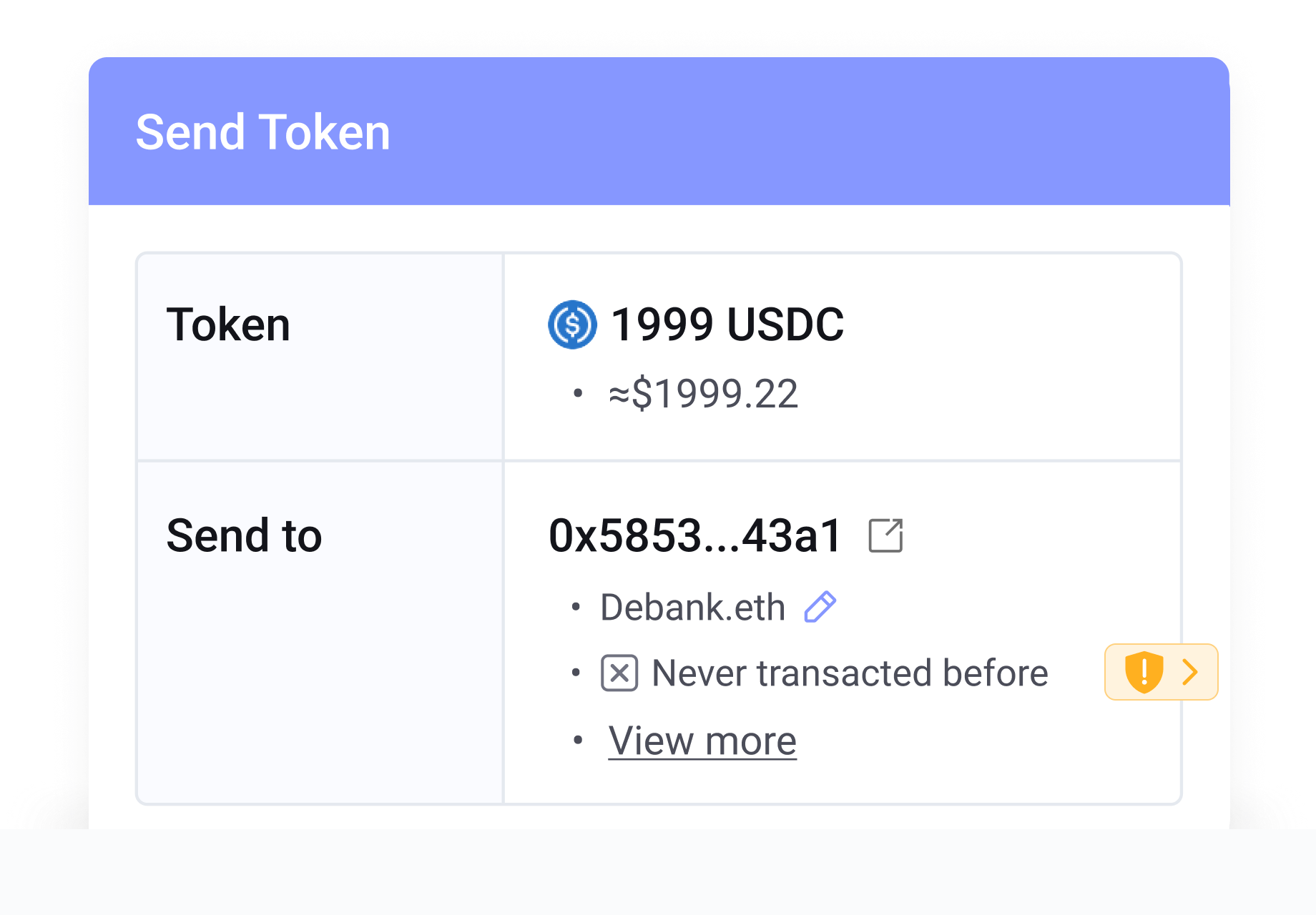
How Rabby’s simulation and pre-transaction scanning actually work (mechanics, not marketing)
At a mechanism level, Rabby simulates the signed transaction locally (or via a controlled node) against a view of current chain state to produce a deterministic outcome: token transfers, allowance changes, and gas consumption. The wallet then presents those estimated token balance changes and the fee cost before the private key is used. This is a crucial distinction from wallets that only display the function signature or raw data: simulation reconstructs the state transition so you can see “what will change” rather than “what data is being sent.”
Complementing simulation, Rabby’s pre-transaction risk scanner flags patterns associated with known hacks, suspicious approval magnitudes, and non-existent recipient addresses. Combined, the two systems work as a two-step filter: simulation answers the “what” and scanning answers the “is this known-bad?” Both are prevention-focused controls designed to reduce blind-signing errors that routinely enable phishing and compromised contract exploits.
Trade-offs: What simulation buys you, and what it doesn’t
Decision-useful trade-offs matter. Simulation reduces surprise and exposes obvious mismatches between intent and effect—but it is not equivalent to formal verification or a crystal ball.
What it reliably does:
- Reveal unexpected token flows and allowance changes before signing, which blocks many common phishing and scam patterns.
- Estimate gas costs so users avoid failed transactions due to gas misconfiguration or wrong network selection (and Rabby helps here with automatic network switching).
- Work across over 90 EVM-compatible chains, preserving consistent UX while you switch networks or interact with layer-2s.
What it does not do or only partially covers:
- It cannot detect zero-day logic bugs in a legitimately deployed contract that appears benign—simulation shows what the contract will do given current state, not whether its internal logic is maliciously misdesigned.
- It depends on accurate chain state; stale or manipulated node responses (in low-trust contexts) can mislead simulation outcomes unless the wallet or user uses trusted RPCs or hardware signers.
- It cannot stop social-engineered approvals where the user is intentionally tricked into signing a valid-looking transaction; human judgment remains the final control.
Side-by-side: Rabby vs MetaMask vs Coinbase Wallet — best-fit scenarios
Three representative alternatives map to different user priorities. Think of the choice as a vector of priorities: security automation, ecosystem compatibility, and institutional features.
Rabby Wallet (best when automation + detailed pre-checks matter): Rabby’s simulation and pre-transaction risk scanning make it ideal for high-frequency DeFi traders and power users who need to reduce blind-signing risk across many chains. Its automatic network switching and native approval-revocation tools reduce friction when hopping between dApps. Rabby’s open-source MIT license plus hardware wallet integrations (Ledger, Trezor, Keystone, and others) support security-conscious individuals and institutions. The trade-off: Rabby lacks a built-in fiat on-ramp and native staking, so users rely on external services for on-ramps or staking strategies.
MetaMask (best when maximum dApp compatibility and developer familiarity matter): MetaMask remains the de facto standard and enjoys near-universal dApp support. It is broadly supported in tooling and tutorials. However, it does not natively simulate transactions with the same UI-driven, human-readable balance change presentation that Rabby provides; MetaMask users often accept transaction details based on function signatures and numerical fields alone, increasing blind-signing risk for complex calls.
Coinbase Wallet (best when user convenience and fiat integration matter): Coinbase Wallet benefits from the Coinbase ecosystem, including easier on-ramps and a consumer-friendly UX. Institutional and power-user features are limited compared with Rabby—specifically, Coinbase Wallet lacks Rabby’s transaction simulation and the depth of approval-revocation features tailored to advanced DeFi flows.
Institutional and hardware workflows: where Rabby wins and where to be cautious
Rabby integrates with Gnosis Safe, Fireblocks, and other custody providers—so teams using multisig workflows can adopt Rabby without changing their signing architecture. Hardware wallet compatibility is broad, enabling a layered security posture: use Rabby for UX and simulation, but sign via Ledger or Trezor to protect keys.
Caveat: institutions should treat simulation as a complement, not a replacement, for established review processes. Simulations report estimated outcomes; governance checks, multi-eye code reviews, and controlled RPC endpoints remain essential for high-value transfers. The 2022 Rabby Swap incident (a smart contract exploit that resulted in about $190,000 in losses) is a reminder that tooling reduces but does not eliminate protocol-level vulnerabilities. The team’s response—freezing the contract and compensating users—shows operational resilience but not immunity to design-level risks.
Practical heuristics and a reusable decision framework
Here are three heuristics to decide when to rely on Rabby’s simulation and when to escalate:
- If the transaction crosses protocols or changes allowances, always require simulation confirmation before signing. Unexpected allowance expansions are a common attack vector.
- For large-value or institutional transfers, pair simulation with an out-of-band code review and sign via hardware multisig. Simulation is a verification step, not an approval policy.
- When using low-liquidity or novel contracts, treat simulation outputs skeptically—run the simulation through a trusted node and, if possible, re-simulate after a short delay to detect state-dependent behavior.
These guidelines map to specific US-centric operational realities: compliance teams may need auditable steps; trading desks require deterministic previews; and retail power users still benefit from rapid, in-browser checks that reduce common human errors.
What to watch next: indicators that would change the assessment
If Rabby expands to include an integrated fiat on-ramp and native staking, it would reduce external dependencies but also increase the attack surface and regulatory exposure in the US market—changes that would require additional controls. Conversely, wider adoption of simulation by other wallets would lower switching costs and push the market toward higher baseline safety.
Signals to monitor:
- Wider industry adoption of transaction simulation as a UX baseline (would indicate maturation of wallet safety norms).
- Changes in RPC decentralization or availability—if public nodes become less reliable, simulation accuracy could degrade without trusted RPCs.
- Regulatory actions in the US around custodial vs non-custodial tooling that could affect how wallets integrate fiat on-ramps or KYC flows.
For readers ready to test Rabby, the team provides downloads and documentation; for context and direct access to the project landing material see https://sites.google.com/cryptowalletextensionus.com/rabby-wallet/. Try simulation on low-stakes transactions first: small swaps and allowance revocations are low-cost ways to learn how the previewed balance changes match real outcomes.
FAQ
Does Rabby’s transaction simulation guarantee I won’t lose funds?
No. Simulation significantly reduces certain classes of risk (unexpected token drains, surprising approval changes, and gas mismatches), but it cannot prevent all losses. It cannot detect malicious on-chain logic that acts within the visible state or prevent users from intentionally signing harmful transactions. Use simulation alongside hardware keys, multisig for large amounts, and standard operational controls.
How does Rabby compare to MetaMask for dApp compatibility?
MetaMask still enjoys the broadest dApp compatibility due to network effects. Rabby supports over 90 EVM chains and includes automatic network switching, which narrows friction for multi-chain DeFi users. If the dApp ecosystem you use is mainstream, both will work; Rabby’s advantage is in its safety automation and simulation UI, which matters more for complex or composable transactions.
Can I use Rabby with hardware wallets for added security?
Yes. Rabby integrates with Ledger, Trezor, Keystone, and several other hardware devices. Combining Rabby’s simulation with hardware signing preserves a strong security posture: you preview outcomes in Rabby and confirm cryptographic signing on an isolated device.
Is Rabby suitable for institutional use?
Rabby integrates with institutional custody and multisig providers like Gnosis Safe and Fireblocks, making it suitable as part of an institutional workflow. However, institutions should retain independent governance checks and controlled RPC endpoints rather than treating simulation as the lone control.
